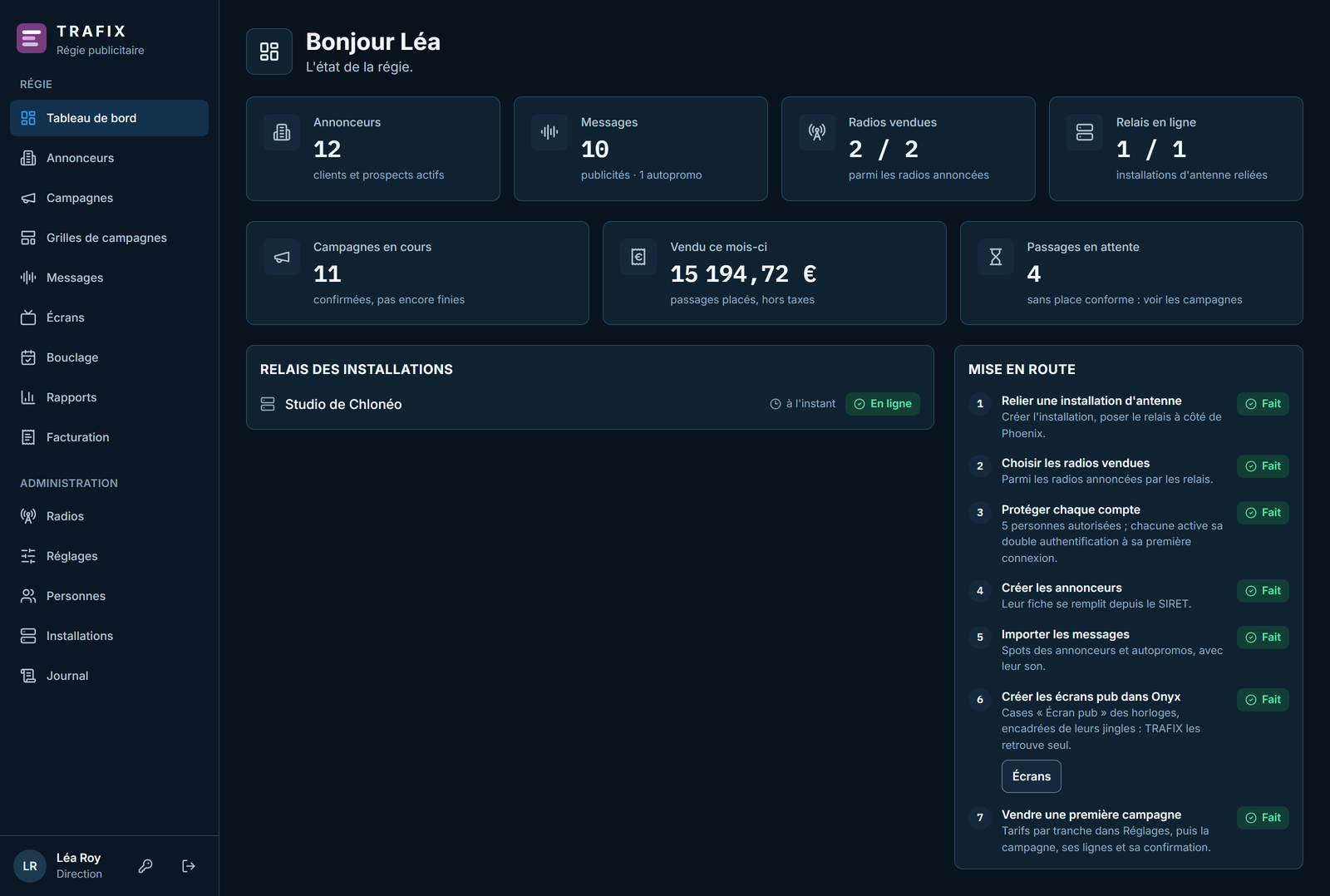
TRAFIX keeps your advertisers and campaigns, places the spots in the ad breaks and sends them to air. Breaks are created in Onyx, Phoenix plays the spots, and proof of broadcast comes back to the sales team. Nothing is entered twice.

From the advertiser record to proof of broadcast, every step is done in TRAFIX or reaches Onyx and Phoenix on its own.
Records filled in from the French company number (SIRET) using public government data. Contacts, parent company, subsidiaries and branches, agency mandates (Sapin law), products.
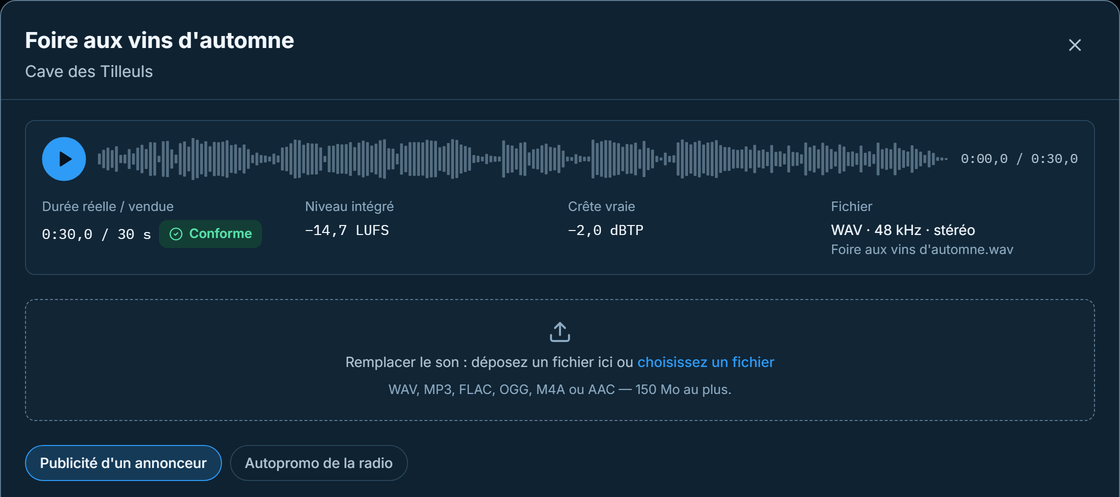
Every sound is measured on upload: exact duration, loudness in LUFS, true peak. MP4 and MOV video spots are accepted, with a picture preview.
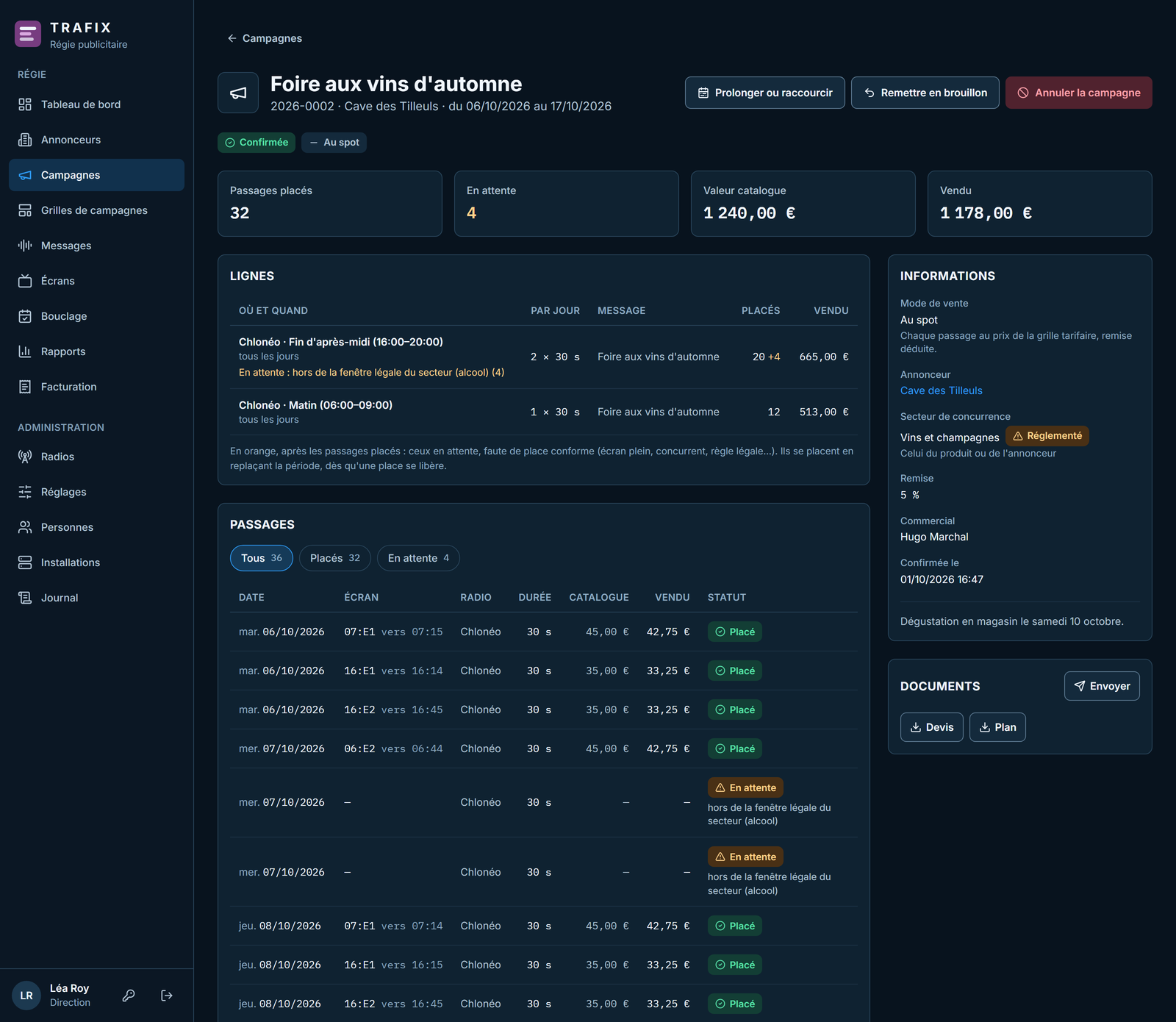
Competitors kept apart by sector, Évin law time windows for alcohol, mandatory mentions checked, banned sectors refused.
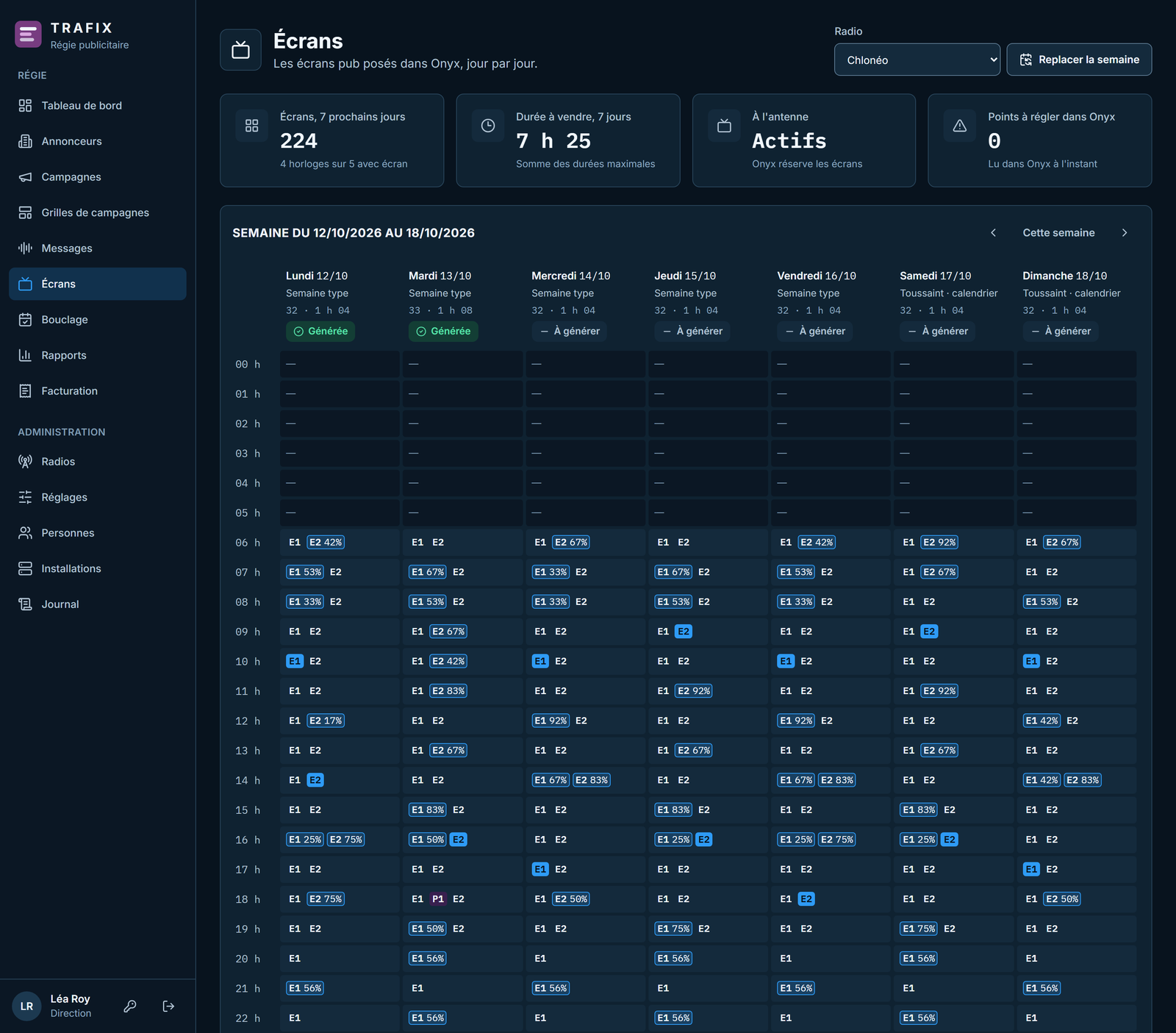
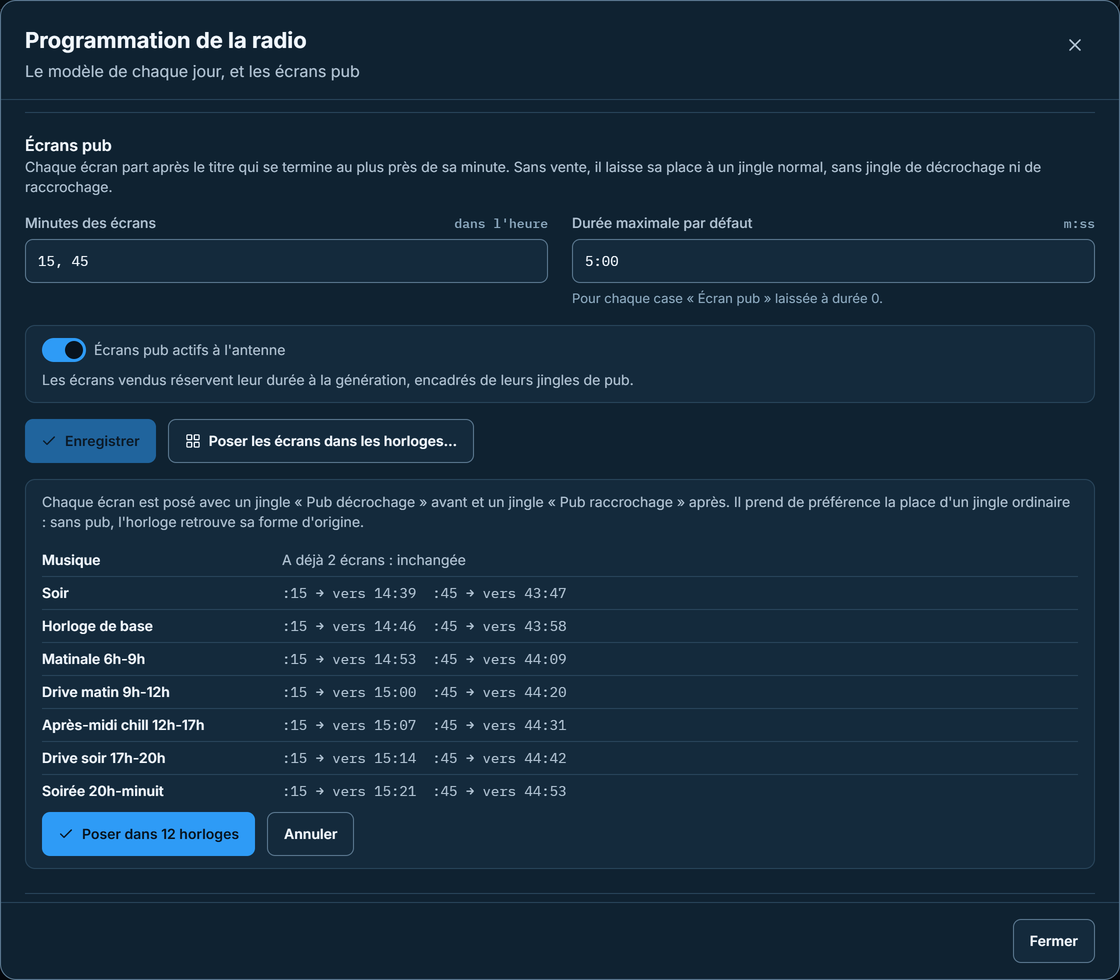
Ad breaks are created in the Onyx clocks, at :15 and :45 by default. TRAFIX finds them on its own: nothing is declared twice.
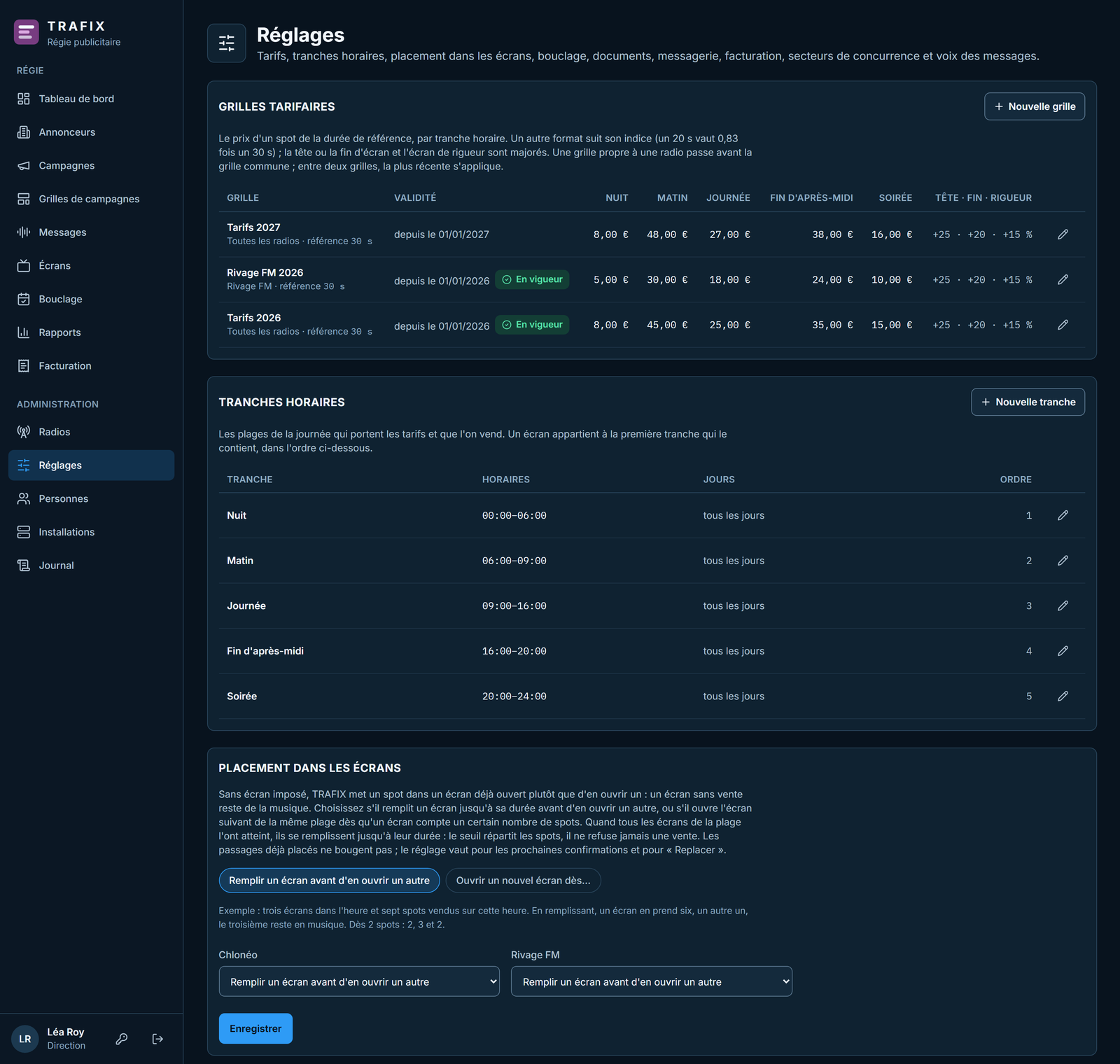
Per-spot sales from the rate card, flat fees and packages, reusable campaign templates, barter, free spots, valued self-promotion.
Room in the break, competition, legal hours, first or last in break: TRAFIX places every spot and fills breaks that are already open first.
Each day is locked automatically on the last working day before it, weekends and public holidays included. A last-minute sale is re-locked from Onyx.
A break lasts what has been sold. Onyx rebalances the hour by swapping a song from the same subcategory, and never touches new releases.
Phoenix plays every spot and reports back the actual time, the duration played and how it ended: normally, cut or skipped.
The on-air chain never depends on the Internet: a relay installed next to Phoenix receives the locked days and their sounds in advance.
The day before, TRAFIX freezes each break: its spots, their order and their sound. A sale that comes in later is re-locked.
The relay stores the day and downloads the sounds, checking their fingerprint. A day is only ready once all its sounds are there.
Onyx places the spots under each break and brings the hour back within ±5 s. If Onyx is closed, Phoenix does it.
Each spot becomes a Phoenix library item, under Commercial, in the advertiser's name: preview, mix points and sound processing like any other item.
A video spot goes to vMix like a music clip. An audio-only spot shows the vMix “advertising” screen.
Actual start time, duration played, ended normally, cut or skipped: the sales team knows what went out, spot by spot.
Pricing is quoted on request, based on the number of stations and on-air installations.
Options: setup by Chloneo, server hosting managed by Chloneo.
TRAFIX already covers the whole on-air chain. What comes next is in preparation.
Invoices, credit notes, reminders and payments, accounting export, e-invoicing through an approved platform.
Advertisers follow their campaigns and approve their spots online. Spot production, from script to edit, is tracked in TRAFIX.
Import of campaigns sent by regional sales houses and agencies.
One server for the sales house, one relay on each on-air installation, and the team's computers.
| Sales house server | Linux, Docker containers, PostgreSQL 18, automatic HTTPS |
| Hosting | Virtual private server in France or Switzerland, or the Phoenix computer for a small station; moving to another host means restoring a backup |
| On-air relay | Windows, on each on-air installation; starts with the computer |
| Workstations | TRAFIX.exe (Windows 10/11 64-bit) or a recent browser, on a computer or a phone |
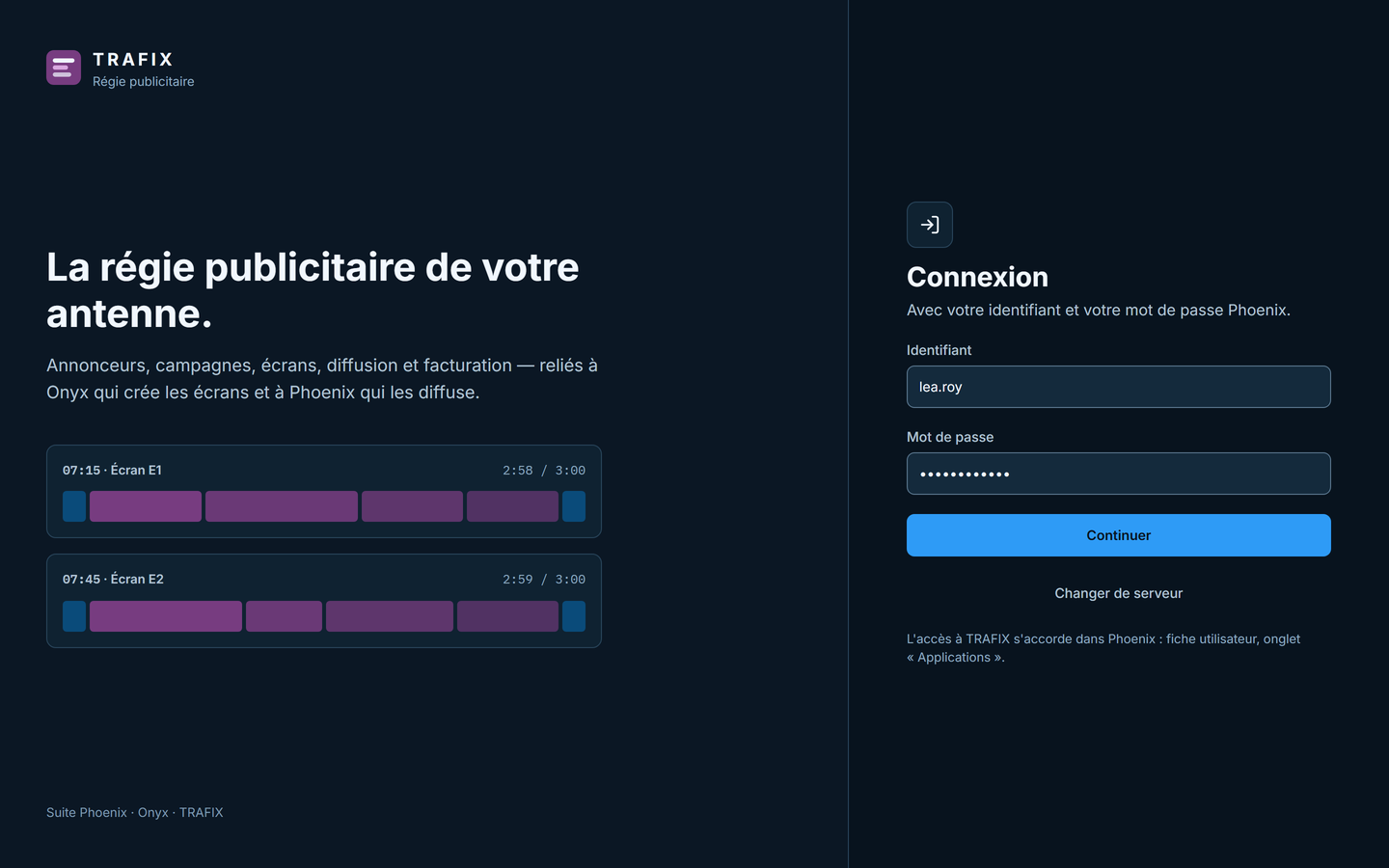
| Sign-in | Phoenix username and password, then a 6-digit code from an authenticator app |
| Audio and video | WAV, MP3, FLAC, OGG, M4A, AAC; MP4, MOV, M4V; 150 MB per file |
| Backups | Database and sounds backed up every night, 30 days of copies |
| Compatibility | Phoenix Pro and Onyx V5, versions with ad breaks |
TRAFIX is installed alongside Phoenix Pro and Onyx. Ask for a demo or a quote for your sales house.